Google May 2026 Update: Why Content Writers Are More Valuable Than Ever
Date
Category
SEO, AEO & AI Search
The Machines Got Smarter. Your Writing Just Became Irreplaceable.
The typical tech headline coming out of mid-May 2026 is entirely wrong.
The media wants you to believe that artificial intelligence is making human writers obsolete. The reality on the ground tells a completely different story: Google is actually reconstructing the open web to favor raw, un-repurposed human expertise.
Between Google I/O 2026 on May 19th, the rollout of the second broad Core Update of the year on May 21st, and the release of their technical documentation on May 15th, the mechanics of how content is discovered, evaluated, and amplified have fundamentally shifted.
If you are running a generic, high-volume content farm, your traffic is about to drop off a cliff. But if you possess deep, first-hand expertise, Google just handed you the keys to the kingdom.
The May 2026 Google Landscape: What Changed?
To understand how to optimize your content, you need to understand the structural tech that Google just deployed globally:
The Rebuilt Search Box & AI Mode: Google’s conversational "AI Mode" has officially crossed 1 billion monthly users, while "AI Overviews" now actively reach 2.5 billion users. The interface is no longer a static index of blue links; it is a dynamic ecosystem powered by Gemini 3.5 Flash as the default global model.
Information Agents (The Summer 2026 Shift): Unveiled at Google I/O, these are always-on background AI assistants. Instead of waiting for a user to type a query, Information Agents scan the web 24/7 - evaluating blogs, news sites, and social platforms - to curate custom, proactive digests for subscribers.
The May 2026 Core Update: Launched on May 21st, this broad algorithm update is actively rolling out. Early data from the Google Search Status Dashboard shows extreme ranking volatility.
The AEO + GEO Documentation: On May 15, Google finalized documentation tackling Answer Engine Optimization (AEO) and Generative Engine Optimization (GEO). The verdict from Search Relations lead John Mueller? AEO and GEO are not separate disciplines from SEO. They are simply the direct consequence of technical data structures meeting Retrieval-Augmented Generation (RAG).
Because the May Core Update is rolling out simultaneously with these massive agentic infrastructure upgrades, search professionals are strongly cautioned to withhold site overhauls until at least one full week after the entire rollout officially concludes.
Why Keywords Don't Matter to an Information Agent (RAG)?
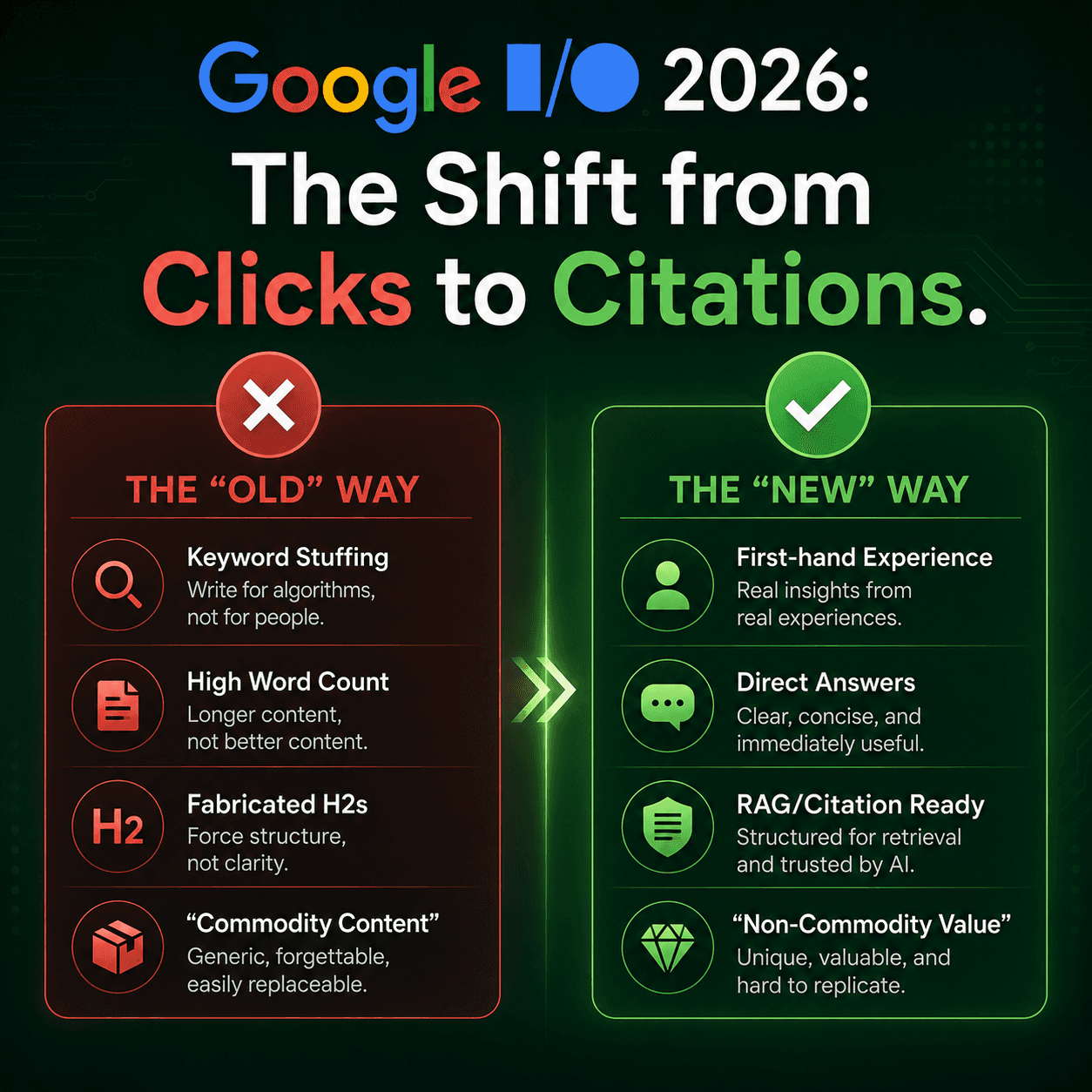
Mainstream marketers are still obsessing over keyword density and semantic H2 headings. They are optimizing for a version of Google that died five years ago.
Modern Large Language Models use a process called Retrieval-Augmented Generation (RAG) to answer user queries. When an Information Agent or a Gemini prompt seeks an answer, it executes a clean, multi-step process:
An AI agent scanning your site at 3:00 AM does not read your content like a human, nor does it log keyword matches like an old crawler. It looks for extractable entity clarity and citation-worthy metrics.
If your article is a 2,000-word block of generic, duplicated research rewritten by a basic LLM prompt, the agent classifies it as "commodity content" and skips it entirely. If your article contains a highly specific, data-backed resolution to a unique problem, the agent extracts it and gives your brand an authoritative citation.
How to Optimize for the Agentic Era?
If you want your content to be cited across Gemini, Perplexity, and background Information Agents, you must completely overhaul your editorial workflow.
1. Hardcode "Answer-First" Document Design
AI systems read hierarchically but retrieve at the passage level. Do not bury your conclusion under an introductory story.
The 40-60 Rule: The very first sentence directly following an H2 or H3 question heading must contain a complete, standalone, direct answer of 40 to 60 words.
The Structure: Use explicit Definition/Explanation pairs, clean tables, and numbered process lists. These are the specific data formatting elements that RAG engines parse with the highest accuracy.
2. Kill Commodity Content; Force E-E-A-T
If your content brief says "Write a comprehensive guide on X keyword," tear it up. Volume for the sake of volume is now an active penalty. Google’s real-time quality signals filter low-value, thin pages faster than ever before.
The In-House Rule: Every content brief must start with a question: "What proprietary data, internal case study, or first-hand experience do we possess on this topic?"
Princeton research has proven that injecting raw statistics, direct expert quotes, and explicit citations increases your AI search discovery rate by 30% to 40% over basic, unoptimized copy.
3. Deploy an llms.txt and Advanced Schema
If the machine cannot decipher your technical identity, it cannot credit your entity.
Ensure your robots.txt explicitly allows access to modern AI scrapers (this remains the number one mistake blocking GEO success).
Implement clean FAQ and Product schema markup across every core page to allow AI algorithms to instantly grab data arrays.
Action Items for Editorial Teams This Week
Run a Citation Audit: Analyze your top 20 traffic-driving URLs. Read them from the perspective of an AI crawler. Is your answer block visible within the first 60 words of a section, or is it hidden behind marketing fluff?
Repurpose for AEO: Add schema-validated FAQ blocks to the footer of every major pillar page. Use conversational, long-tail questions that match how humans speak naturally into an AI interface.
Incentivize Subject Matter Experts (SMEs): Stop relying entirely on isolated content generalists. Pair your writers directly with your technical, product, or executive teams to extract authentic, non-commodity insights.
The competitive landscape has permanently cracked wide open. Generic content marketing is dying, but elite, deeply human, structurally optimized writing has never been more valuable.
The bar just got higher. Clear it, and the algorithms will work for you.
FAQ's
Q: What is the May 2026 Google Core Update?
Launched on May 21, 2026, this is Google's second broad core algorithm update of the year. It is rolling out alongside infrastructure overhauls to Search, focusing heavily on filtering low-quality commodity text and adjusting rankings as AI Mode usage grows.
Q: How do Google Information Agents choose their sources?
Information Agents use real-time RAG (Retrieval-Augmented Generation). They analyze the open web for distinct entity data, verifiable source citations, and precise solutions to user-defined tracking prompts, bypassing generic or programmatic content farms.
Q: Is GEO separate from traditional technical SEO?
No. Official guidance from Google's search relations team confirms that Generative Engine Optimization relies entirely on a foundation of flawless technical SEO, crawlability, and deep topical authority. You do not abandon SEO to achieve GEO success; you layer GEO on top of it.
More Post


Subscribe to Our Newsletter
Join now and never miss out on our stuff again. Because you are worth it!
Copyright © Anujfolio| Designed by Anuj Chaturvedi - Powered by Framer